The $5500+ Mistake: Tax Deductions Australian Sole Traders Keep Missing (And How to Fix It)
Are you an Australian Sole Trader and constantly get stuck when it comes to tax time? You're not alone.
Tax can be confusing at the best of times, leading many Sole Traders to make mistakes costing them more than $5,500 each year, according to a June 2023 survey of 504 Australian sole traders commissioned by Hnry. Imagine what your business could look like if that $5,500+ was going back into it rather than out.
I'm going to share some strategies to help you understand what expenses can be deductible at tax time, as well as how to stop making these costly tax mistakes.
Before I deep dive into this, I wanted to take a moment to acknowledge the importance of education and organisation when it comes to tax.
The more you understand about tax, the more confident you become in knowing what you can and can't claim. Additionally checking the ATO Deductions for Small Business Guide each year is a really useful tool, as it ensures you are always in the loop, helping you identify eligible claims you may have overlooked. And who knows there could be expenses you can claim this year that you couldn't last, and you wouldn't have known otherwise if you hadn't checked the site.
How many times during tax have you been left guessing on how much fuel you have used for your business, or what portion of your electricity bill comes from running your business from home?
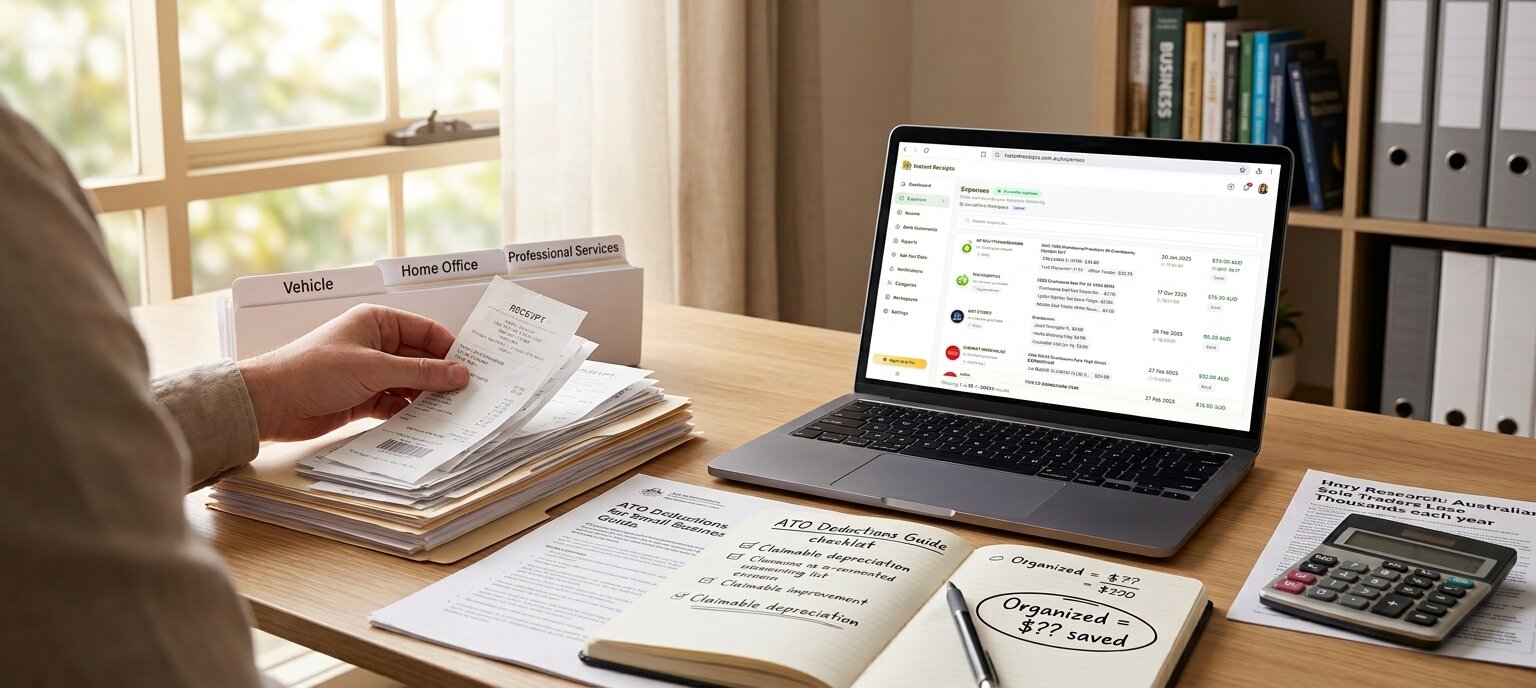
The ATO's Random Enquiry Program found that poor record keeping is one of the biggest causes of tax mistakes among small businesses. Businesses that maintain accurate records are significantly less likely to make reporting errors. (Not sure what counts as a valid record? See our guide to ATO receipt requirements.) Keeping a diary of your expenses is the key to ensuring you're making the most out of your claims, whilst also not claiming too much!
How many times have you gone "I've probably used about $3000 in fuel for my business this financial year" and rely on that rough figure. I'm here to let you in on a little secret, that rough figure could be costing you! What happens when you record your business fuel costs for the financial year and figure out you actually use $4100 in fuel per year and not $3000. All those missed claimed dollars add up significantly over the years!
On the flip side, if you have been claiming too much, you might be in pocket as of now. The risk comes into play if you get audited and the ATO determines you've been claiming too much, landing you a costly fine! ATO research has found that over-claimed deductions account for approximately 25% of the small business tax gap. Keeping a diary provides you with confidence in what you're claiming, whilst maximising your return at the same time. What a win! This tool might seem like it will take up a lot of time, but that extra 20 mins a week could save you hundreds or even thousands a year.
Here's some insider knowledge into the most common tax deductions Sole Traders miss out on, and most importantly how to avoid it from now on!
What can you claim as a sole trader in Australia?
As a sole trader, you can claim any expense directly related to earning your business income, provided it isn't private in nature and you have a record to prove it. If you operate as an independent contractor under an ABN, these same deductions apply to you as a sole trader. The most commonly missed deductions fall into eight categories:
- Vehicle and business travel
- Phone and internet (business-use portion)
- Self-education, courses and professional memberships
- Software and subscriptions
- Home office running costs
- Bank fees and tax agent costs
- Income protection insurance
- Tools and equipment (via the instant asset write-off)
Each is covered in detail below, including how to substantiate the claim so it holds up if the ATO asks.
1. Vehicle and Travel Expenses
Most Sole Traders don't realise everyday travel to and from work isn't deductible. That's because if you think about it, technically everyone has to travel to and from work whether you're a Sole Trader or not!
Where a lot of people come undone is failing to claim legitimate business-related trips between client sites, supplier visits, or job locations.
To ensure this doesn't happen to you, keep a compliant logbook that clearly demonstrates your business related percentage of your travel. You can alternatively use the cents-per-km method, which claims a set rate per business kilometre (91 cents for the 2026–27 income year) for up to 5,000 business kilometres per car, with no logbook required.
If you buy a vehicle for your business rather than just claiming running costs, you may also be able to write it off under the instant asset write-off scheme, on top of (not instead of) your logbook or cents-per-km claims for ongoing use.
2. Phone and Internet
Sole traders can also claim their mobile and internet plans. For example, If you are an uber driver you are using the plan to actually receive jobs or if you are tradie you need a mobile phone to call your customers or scheduled bookings. If you work from home and use the ATO's fixed rate method (70 cents/hour), your phone and internet are already included in that rate. If you claim them separately it's a double claim and ATO will catch it. If you have a separate phone or multiple SIM cards purely for business use as Uber drivers mostly have multiple phones and SIM cards. This is fully deductible as standalone business expense, separate from your home office calculation entirely.
3. Self-Education and Subscriptions
A lot of sole traders don't realise they can claim online training courses, industry-specific magazines, professional memberships and seminars. Just have a good think about how much these tools cost you per year, Are you claiming them? Many sole traders aren't.
If the educational resources you're purchasing directly relates to your businesses current income-earning, you should visit the ATO Self-Education Expenses to uncover exactly what you can claim. And I can guarantee you'll be surprised by how much you can!
4. Software and Subscriptions
Sole traders can also claim their software subscriptions e.g. if you are using Xero, Quickbooks, design apps, project management platforms to sort out your documents or your schedule all this software is tax deductible. Most people do know that these are tax deductibles but mostly these subscriptions auto-renew in the background after a month or year later so they forget these minor transactions at tax time. Any software which requires you to fulfill your duties as a sole trader or a business owner you can claim these.
5. Home Office Running Costs
Did you know that Sole Traders often forget to claim the business portion of their internet, electricity and gas. This is because it's easy to forget these hidden expenses, but they do exist and can add up significantly, especially if you predominantly operate from home!
To combat this, ensure to track your at-home costs. This can be made simple via the ATO's fixed-rate method, allowing you to claim up to $0.70 per hour for running expenses, and don't forget to use a diary to accurately record it!
6. Bank Fees and Tax Agent Costs
Do you ever dread paying an accountant to Do your tax return? What if I told you it's possible to make a tax claim on the fees you pay your accountant! The only catch is that you can only make your claim in the next year's tax return. But keep in mind, tax is done every year so you'll always get it back(it will just be the fees from the year before you'll be getting). Do you ever look at your bank statement and sigh at the $10 monthly account keeping fee on your business account, and whilst you're at it notices the payment processing costs coming from your Square account. What if I told you it's also possible to claim these expenses through tax!
To make sure you don't miss out on claiming these expenses again, review your annual bank statements and myTax records to make sure you put all of your financial/ administrative service charges through as deductions.
7. Income Protection Insurance
Being a sole trader or a solo entrepreneur have some benefits as well as some drawbacks. You can be your own boss, work at your own pace and time to fulfill your other family duties at ease. But the main drawback is there are no sick leaves, annual leaves or superannuation by the employer. You need to manage these by yourself. Sole traders or business owners can protect themselves by taking income protection insurance. If you are unable to work due to illness, injury, or disability this insurance pays a portion of your income mostly up to 70% of your pre-tax monthly income. Mostly there is a cap on the benefits between $10,000 and $15,000 per month. But still this is an expense for you as a sole trader and gives you peace of mind also these premiums are fully tax deductible.
8. Immediate Asset Write-Offs
A big misconception that Sole Traders make is thinking you can only write off assets individually over years. But what if I told you, it can be possible to take immediate deductions for eligible purchases. By using the Instant Asset Write-Off, you can instantly claim the full cost of eligible depreciating assets in the year you buy and first use them, provided each asset costs less than the threshold — $20,000 per asset for small businesses with turnover under $10 million. This $20,000 limit is locked in for the 2025–26 year and has been proposed to continue from 1 July 2026, but confirm the current status on the ATO website before relying on it.
Fun fact! if you purchase an item for your business that is $300 or less, you could be eligible to claim an immediate outright deduction.
Conclusion
Turns out when you're a Sole Trader saving more than $5,500 a year isn't difficult when you have the right education, tools and resources and know exactly what to look out for. The ATO's research suggests the biggest issue when it comes to Tax time for Sole Traders isn't necessarily deliberate tax evasion. It's incorrect reporting caused by poor records, misunderstandings of deductions, and omitted income. When you're educated and confident in your decisions, each year when tax time rolls around it becomes less and less daunting, and eventually won't feel like the burden it currently seems to be.
Frequently Asked Questions
What is a tax deduction for a sole trader in Australia?
A tax deduction reduces your taxable income. It means basically you pay less tax on what you earn. If e.g. you earn $70,000 per year and claim $10,000 in legitimate business expenses. You are only taxed on $60,000. The ATO allows tax deductions of expenses which are directly related to income, provided you have records/receipts to prove them.
What business expenses can Australian sole traders legally claim?
All the expenses incurred in running your business and earning income are potentially deductible. E.g. Vehicle costs, home office expenses, phone and internet, software subscriptions, tools and equipment, bank fees, tax agent fees, income protection insurance. Two conditions apply: the expense must be business related, not personal and you have records to prove them. Knowing exactly which expenses as a sole trader you can claim, and keeping the right records for each, is what separates a full claim from a missed one.
What are the most commonly missed tax deductions for sole traders?
Software subscriptions are the most common missed tax deductions as most of them auto renew in the background after a year or a month most people forget about these. There are also some other categories like income protection premiums, the business use of phone and internet, home office running costs, tax agent fees, instant write-offs on equipment are among the major ones. These are missed not because people don't know they're deductible, but because small recurring charges slip past unrecorded during the year.
Why do so many sole traders lose money through poor record keeping?
If you don't keep records you will be guessing at tax time and estimates are lower than reality. The ATO's own research found poor record keeping is the primary reason for incorrect tax reporting among sole traders. In most cases they are not deliberately trying to evade tax. So every dollar you can't substantiate is a dollar you can't claim.
What records does the ATO require to support tax deductions?
To claim tax deductions in most cases you need a receipt or invoice showing the date, amount, supplier name, what was purchased. For vehicle claims you need either a logbook of trips also you can claim cents-per-km for business trips only capped at 5,000km. A logbook needs to cover 12 continuous weeks. For home office expenses you need to record the number of hours you worked from home to claim deductions.
How long should sole traders keep receipts and tax records?
Any sole traders or business owner should keep their receipts for at least 5 years even after BAS lodgement or tax returns lodgement. This applies to receipts, invoices, logbooks, bank statements. The ATO can request records for any return within that window.
Can I claim a business expense if I have lost the receipt?
The ATO requires written evidence for all claims but a lost invoice doesn't disqualify the deduction. Acceptable alternatives include bank statements or credit card statements showing the transaction or a supplier invoice. In some cases ATO does request statutory declarations. If your total claimed expenses are under $300 in value then you don't need to provide the receipts. Note: this $300 applies to employees only those who are claiming their work related expenses.
Are digital receipts accepted by the ATO?
Yes. The Australian taxation office accepts digital copies of the receipts e.g. images, pdfs, photos. The only conditions are that they are true copies of the original receipt and are clearly visible, readable and not blurry. You don't need to keep the original paper if a digital copy exists. Instant Receipts app fulfills this requirement for you.
Can sole traders claim home office expenses?
Yes. The ATO offers two methods: the fixed-rate method(70 c/hour) for every hour you worked from home, covering gas, phone, internet, electricity and stationery. Under the fixed rate method you must keep a record of hours worked from home for a full income year. Estimates are not accepted. The second method is the actual cost method which is calculating the real business-use proportion of each expense separately e.g. depreciation on work assets like a desk, chair, or computers, printers can also be claimed separately.
Can I claim my phone, internet, software subscriptions, and AI tools like ChatGPT as business expenses?
Yes if they are used for business purposes. Phone and internet and software subscriptions are claimable at the business-use percentage. If you are using a fixed-rate method, home office expenses, phone and internet are already included in that 70 cents per hour so you don't need to claim them again. Software subscriptions like AI tools used to operate your business e.g. creating social media campaigns or figma to create designs are fully deductible.
What is the difference between deductible and non-deductible business expenses?
A deductible expense is directly incurred in earning your income .e.g you are a tradie you need to drive to get to the job site this is deductible business expense. Non-deductible expenses are those which are personal in nature. E.g you are a tradie: you need to drive to your head office to pick up your tools then get to the job site. Driving to your head office won't come under the business expense but driving to your job site does. Now in this case it's a mixed expense you can claim deductions for your business use.
What is the best way to organise receipts and business expenses throughout the financial year?
When you are purchasing something at that moment, capture and store the receipt. You can use Instant Receipts to get it in the system as soon as you spend the money. Make sure to categorise it into ATO expense categories or your own defined categories. By BAS lodgement or EOFY it will be too difficult to accurately reconstruct each transaction. Keep business and personal expenses separately in the app. Do a quarterly review of unmatched auto renewing subscriptions.